
London Travel Tips From Frequent Visitors: Insider Advice for 2026

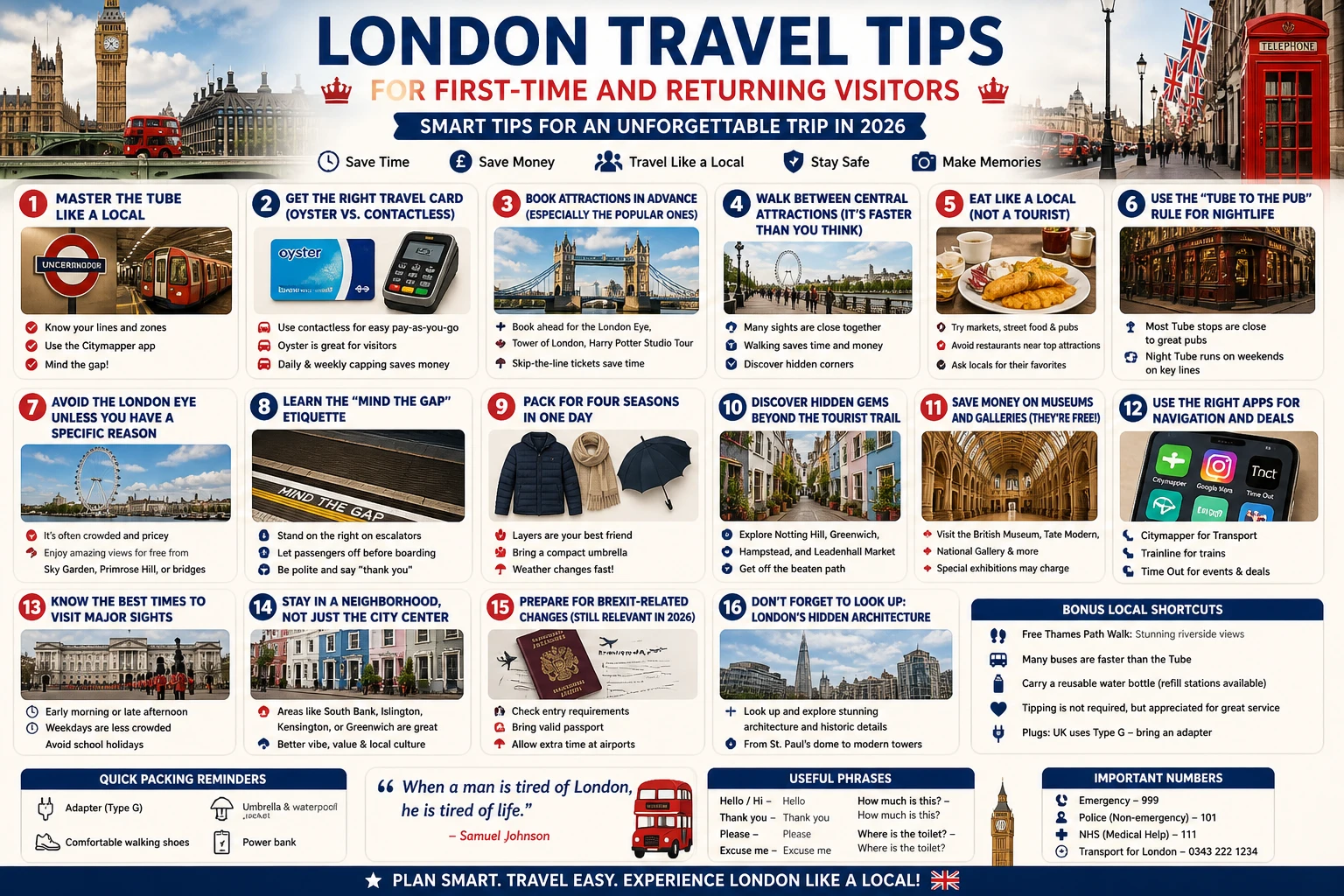
Planning a trip to London can feel overwhelming with so much to see, do, and navigate—especially if you’re short on time or on a budget. Don’t worry, though: these London travel tips will help you skip the tourist traps, save money, and experience the city like a local. From mastering the Tube to finding free attractions and avoiding crowds, this guide has everything you need for a smooth, memorable visit in 2026.
Essential London Travel Tips for First-Time and Returning Visitors
London is a sprawling, dynamic city that rewards a little preparation. Whether you’re here for the history, the food, or the shopping, these insider tips will make your trip easier, cheaper, and way more fun.
1. Master the Tube Like a Local
Best for: All travelers looking to save time and money
Address: Tube stations across London (Central Line is busiest)
Hours: Most lines run 5:00 AM to midnight (some 24-hour on weekends)
Price: Single fare from £2.80 (peak) to £2.60 (off-peak) with contactless
The London Underground is your best friend—but only if you know how to use it right. First, always use contactless payment (your phone, card, or Oyster card) instead of buying paper tickets. It caps your daily fare automatically, so you’ll never overpay. Pro tip: Avoid the Tube between 7:30–9:30 AM and 5:00–7:00 PM on weekdays unless you enjoy being squished like a sardine. If you’re staying central, consider walking instead—many attractions are closer than they look on the map. Also, download the TfL Go app for real-time updates and route planning. Finally, remember to stand on the right on escalators, or you’ll get some serious side-eye from locals.
2. Get the Right Travel Card (Oyster vs. Contactless)
Best for: Budget-conscious travelers
Price: Oyster card costs £7 deposit (refundable); contactless has no fee
One of the most common mistakes tourists make is buying a paper Travelcard or single tickets. Instead, use a contactless debit/credit card or an Oyster card. Both work on the Tube, buses, trams, and most trains within London. The daily cap is the same—around £8.50 for Zones 1-2 in 2026. If you’re here for more than a week, consider a weekly Travelcard. But for short trips, contactless wins because you don’t need to queue for a refund. Important: Always use the same card for all journeys to get the cap. And if you have an Apple Watch or Google Pay, that works too! Buses are cheaper than the Tube (only £1.75 per ride) and give you great views above ground.
3. Book Attractions in Advance (Especially the Popular Ones)
Best for: Avoiding long queues and disappointment
Address: Various (e.g., Tower of London, British Museum, London Eye)
Hours: Vary by attraction
Price: Free to £40+ depending on the site
If you want to see the Tower of London, Westminster Abbey, or the London Eye without wasting hours in line, book tickets online at least a week ahead—especially in summer or during school holidays. Many attractions have timed entry slots, and they sell out fast. For the British Museum, Natural History Museum, and other free museums, you still need to reserve a free timed ticket online (yes, even for free entry). This is one of the most overlooked London travel tips that can save you two hours of queuing. Also, consider a London Pass if you plan to see 3+ paid attractions in a day—it often includes skip-the-line privileges. But don’t buy it unless you actually do the math; it’s not always worth it.
4. Walk Between Central Attractions (It’s Faster Than You Think)
Best for: Fit travelers who love exploring
London is more walkable than most people realize. Sure, the Tube is convenient, but walking between central sights often saves time because you don’t need to descend into stations, wait for trains, and climb back up. For example, it’s only a 15-minute walk from Trafalgar Square to the Houses of Parliament, or 20 minutes from Covent Garden to St. Paul’s Cathedral. Plus, you’ll stumble upon hidden alleys, street performers, and cozy pubs. Wear comfortable shoes—you’ll easily clock 10–15 miles a day. And if you get tired, hop on a red double-decker bus (route 11 or 15 are scenic). Walking also helps you avoid the dreaded “Tube crush” during peak hours.
Walk Between Central Attractions (It’s Faster Than You Think) is one of the most practical ideas in this London Travel Tips From Frequent Visitors: Insider Advice for 2026 guide because it helps travelers avoid avoidable costs, stress, and last-minute mistakes. Using this advice early in your planning process can improve budgeting, save time on the road, and make your overall trip run more smoothly.
For anyone using london travel tips from frequent visitors: insider advice for 2026 to plan smarter, this tip matters most when you want better day-to-day travel decisions. Treat it as a repeatable habit rather than a one-time trick, and it will keep delivering value before departure and throughout the trip.
5. Eat Like a Local (Not a Tourist)
Best for: Foodies on a budget
Address: Borough Market, Brixton Village, or local pubs
Hours: Vary
Price: £5–£15 for a meal
Forget the overpriced restaurants in Leicester Square. Instead, head to Borough Market (closed Sundays) for fresh street food—try the grilled cheese or paella. For a classic pub lunch, find a “gastropub” like The Harwood Arms or The Eagle. Fish and chips? Go to Poppie’s or a local chippy, not a tourist trap. And if you’re on a budget, Pret a Manger, Wasabi, or Itsu offer decent sushi and sandwiches for under £7. Sunday roasts are a must—book a pub like The Spaniards Inn or The Gunmakers for the full experience. Also, don’t forget to try a full English breakfast at a café (not a hotel) for around £8–£12. Avoid eating in touristy areas like Covent Garden’s main square—walk two streets away and prices drop 30%.
6. Use the “Tube to the Pub” Rule for Nightlife
Best for: Night owls and pub crawlers
Address: Various (e.g., The Churchill Arms, Ye Olde Cheshire Cheese)
Hours: Pubs open until 11 PM–midnight (some later)
Price: £5–£7 per pint of beer
London’s nightlife is legendary, but getting home can be tricky. The Tube stops around midnight, and night buses can be slow. My tip: Plan your last Tube ride before 11:30 PM, then switch to night buses or taxis. Better yet, stay in a pub near your accommodation for the last round. If you’re out late, Uber and black cabs are available but pricey (a 15-minute ride can cost £25+). For a unique experience, visit a “speakeasy” bar like The Mayor of Scaredy Cat Town or Nightjar (book ahead). And remember: pubs close at 11 PM on weeknights, but bars and clubs stay open until 2–3 AM. Always carry your ID—London is strict about age checks.
7. Avoid the London Eye Unless You Have a Specific Reason
Best for: First-time visitors with extra cash
Address: Riverside Building, County Hall, London SE1 7PB
Hours: 10 AM–8:30 PM (varies by season)
Price: From £38 per adult (online)
I know, I know—the London Eye is iconic. But honestly, it’s overpriced and often crowded. A 30-minute ride costs nearly £40, and you’ll be sharing a capsule with 20 other people. Instead, get a better view from The Sky Garden (free, book ahead) or One Tree Hill in Honor Oak (free, no booking). Even the Tate Modern’s viewing platform is free and offers stunning river views. If you really want a Ferris wheel experience, wait for a clear day and book an early morning slot to avoid queues. But for most travelers, this is an easy skip—use the money on a Thames River cruise instead (from £12).
8. Learn the “Mind the Gap” Etiquette
Best for: Avoiding social faux pas
This might sound silly, but Londoners have unspoken rules that can make or break your trip. First, never block the escalator—stand on the right, walk on the left. Second, let people off the Tube before you get on. Third, don’t stop suddenly in the middle of a busy pavement (sidewalk). Fourth, avoid eye contact on the Tube unless you’re asking for directions. Fifth, queue properly—Brits take queuing very seriously. And finally, don’t use your phone speaker on public transport (it’s the ultimate sin). Follow these rules, and locals will warm to you instantly. Break them, and you’ll get some very British passive-aggressive sighs.
Learn the “Mind the Gap” Etiquette is one of the most practical ideas in this London Travel Tips From Frequent Visitors: Insider Advice for 2026 guide because it helps travelers avoid avoidable costs, stress, and last-minute mistakes. Using this advice early in your planning process can improve budgeting, save time on the road, and make your overall trip run more smoothly.
For anyone using london travel tips from frequent visitors: insider advice for 2026 to plan smarter, this tip matters most when you want better day-to-day travel decisions. Treat it as a repeatable habit rather than a one-time trick, and it will keep delivering value before departure and throughout the trip.
9. Pack for Four Seasons in One Day
Best for: All travelers, especially in spring/fall
London weather is famously unpredictable. You can experience sunshine, rain, wind, and cold all in a single afternoon. My advice: Pack layers—a light jacket, a sweater, and a waterproof coat. Always carry a small umbrella (but expect it to break—London wind is brutal). In summer (June–August), temps hit 25°C (77°F) but can drop to 15°C at night. In winter, it’s rarely below freezing but feels colder due to humidity. And here’s a secret: November to February is the cheapest time to visit for flights and hotels, but you’ll need a warm coat. For 2026, pack a reusable water bottle (tap water is safe) and a power bank—you’ll use your phone for maps and tickets constantly.
10. Discover Hidden Gems Beyond the Tourist Trail
Best for: Adventurous travelers seeking authenticity
Address: Various (e.g., Little Venice, God’s Own Junkyard, Postman’s Park)
Hours: Vary
Price: Free to £10
While Big Ben and Buckingham Palace are must-sees, don’t miss London’s quirky side. God’s Own Junkyard in Walthamstow is a neon sign museum that’s Instagram gold. Little Venice offers peaceful canal walks and narrowboat cafes. Postman’s Park hides a touching memorial to heroic self-sacrifice. The Viktor Wynd Museum of Curiosities is a bizarre cabinet of oddities. And for a proper local experience, explore Greenwich Market or Columbia Road Flower Market (Sundays only). These spots are less crowded, cheaper, and give you a real taste of London life. Use the Citymapper app to find them—it’s better than Google Maps for public transport.
11. Save Money on Museums and Galleries (They’re Free!)
Best for: Budget travelers and culture lovers
Address: British Museum (Great Russell St, WC1B 3DG), National Gallery (Trafalgar Sq, WC2N 5DN)
Hours: 10 AM–5:30 PM (most)
Price: Free (special exhibitions cost extra)
One of the best London travel tips is that many world-class museums are completely free. The British Museum (with the Rosetta Stone and Egyptian mummies), Natural History Museum (dinosaurs!), Tate Modern (modern art), National Gallery (Van Gogh, da Vinci), and Victoria and Albert Museum (design and fashion) all charge £0 for general admission. You do need to book free timed tickets online, though. Plan to spend 2–3 hours per museum, and avoid weekends if possible (school trips are common). Donations are welcome but not required. Special exhibitions (like the Tutankhamun show) cost extra, but the permanent collections are world-class.
12. Use the Right Apps for Navigation and Deals
Best for: Tech-savvy travelers
Price: Free (apps)
Your phone is your best travel tool in London. Download these before you arrive:
– Citymapper (better than Google Maps for public transport)
– TfL Go (official Tube and bus updates)
– Trainline (for train tickets outside London)
– Too Good To Go (discounted food from restaurants)
– Visit London (official guide with deals)
– Uber (for late-night rides)
– WhatsApp (many restaurants use it for reservations)
Also, turn off mobile data roaming unless you have a good plan—London has free Wi-Fi in most Tube stations, cafes, and museums. For calls, use Wi-Fi calling. And always screenshot your tickets and maps before you go underground (no signal on the Tube).
Use the Right Apps for Navigation and Deals is one of the most practical ideas in this London Travel Tips From Frequent Visitors: Insider Advice for 2026 guide because it helps travelers avoid avoidable costs, stress, and last-minute mistakes. Using this advice early in your planning process can improve budgeting, save time on the road, and make your overall trip run more smoothly.
For anyone using london travel tips from frequent visitors: insider advice for 2026 to plan smarter, this tip matters most when you want better day-to-day travel decisions. Treat it as a repeatable habit rather than a one-time trick, and it will keep delivering value before departure and throughout the trip.
13. Know the Best Times to Visit Major Sights
Best for: Avoiding crowds
Address: Various
Hours: Vary
Price: Free to £30
Timing is everything in London. For the Tower of London, go right when it opens at 9 AM (weekdays) to avoid school groups. Buckingham Palace changing of the guard happens at 11 AM but is packed—see it from St. James’s Park instead. Westminster Abbey is quietest at 4 PM. Camden Market is best on weekdays (weekends are chaos). The Shard viewing platform is cheaper at sunset (book ahead). And for Harry Potter Studio Tour, book months in advance—it sells out fast. General rule: Visit popular spots at opening time or 2 hours before closing for the smallest crowds.
Know the Best Times to Visit Major Sights is one of the most practical ideas in this London Travel Tips From Frequent Visitors: Insider Advice for 2026 guide because it helps travelers avoid avoidable costs, stress, and last-minute mistakes. Using this advice early in your planning process can improve budgeting, save time on the road, and make your overall trip run more smoothly.
For anyone using london travel tips from frequent visitors: insider advice for 2026 to plan smarter, this tip matters most when you want better day-to-day travel decisions. Treat it as a repeatable habit rather than a one-time trick, and it will keep delivering value before departure and throughout the trip.
14. Stay in a Neighborhood, Not Just the City Center
Best for: Authentic experiences and lower prices
Address: Shoreditch, Notting Hill, Greenwich, or Brixton
Price: Hotels from £80–£200 per night
While staying near Oxford Circus is convenient, it’s also noisy and expensive. Instead, choose a neighborhood that matches your vibe. Shoreditch is hipster heaven with street art and cool bars. Notting Hill is charming with pastel houses and Portobello Market. Greenwich feels like a village with the Cutty Sark and a great market. Brixton is multicultural and vibrant with amazing food. These areas are well-connected by Tube or bus, and you’ll get a more local experience. Plus, restaurants and pubs are cheaper than in zone 1. For 2026, look for apartments on Airbnb or hotels in zone 2 for the best value.
15. Prepare for Brexit-Related Changes (Still Relevant in 2026)
Best for: All travelers
Even though Brexit happened years ago, some rules still trip up tourists in 2026. You now need a valid passport with at least 3 months left before expiry. EU citizens need to apply for an Electronic Travel Authorization (ETA) online before traveling (costs £10, valid for 2 years). Non-EU visitors may need a visa (check gov.uk). Also, duty-free shopping rules have changed—you can bring in limited alcohol and tobacco. And remember: the UK uses pounds (£), not euros, and most places are cashless (cards accepted everywhere). Finally, travel insurance is essential—NHS healthcare is free for emergencies but not for other medical needs.
Prepare for Brexit-Related Changes (Still Relevant in 2026) is one of the most practical ideas in this London Travel Tips From Frequent Visitors: Insider Advice for 2026 guide because it helps travelers avoid avoidable costs, stress, and last-minute mistakes. Using this advice early in your planning process can improve budgeting, save time on the road, and make your overall trip run more smoothly.
For anyone using london travel tips from frequent visitors: insider advice for 2026 to plan smarter, this tip matters most when you want better day-to-day travel decisions. Treat it as a repeatable habit rather than a one-time trick, and it will keep delivering value before departure and throughout the trip.
16. Don’t Forget to Look Up: London’s Hidden Architecture
Best for: Architecture enthusiasts and photographers
Address: Throughout the city
Price: Free
One of my favorite London travel tips is to constantly look up. London’s skyline is a mix of medieval, Victorian, and modern architecture that most tourists miss because they’re staring at their phones. Notice the gargoyles on Westminster Abbey, the art deco details on the Hoover Building, the glass dome of the British Museum, and the colorful tiles on Tube stations (like Baker Street’s Sherlock Holmes theme). Take a free walking tour (tip-based) with Free Tours by Foot to learn the stories behind the buildings. And don’t miss St. Pancras Station—it’s one of the most beautiful train stations in the world, with a statue of lovers meeting at the clock.
Conclusion
London is a city that rewards those who prepare a little and explore a lot. By following these London travel tips, you’ll save money, avoid crowds, and experience the capital like a true insider. Remember to use contactless payment on the Tube, book popular attractions in advance, and always carry an umbrella—just in case. Whether you’re wandering through the British Museum’s ancient halls, sipping a pint in a hidden pub, or watching the sunset from the Sky Garden, London will surprise and delight you at every turn. So pack your walking shoes, download Citymapper, and get ready for an unforgettable adventure. Cheers!
similar posts
Where to Stay in San Diego in 2026: Best Neighborhoods & Hotels
17 Essential Travel Photography Tips for 2026: Capture Your Adventures Like a Pro
The Ultimate Guide to the Top 10 Places to Visit in the World in 2026
15 Essential Business Travel Tips for 2026: Work Smarter on the Road
15 Must-See Places to Visit in the US in 2026
Best Time to Visit the Grand Canyon in 2026