
When Is the Best Time to Visit Ireland? A Season-by-Season Look for 2026

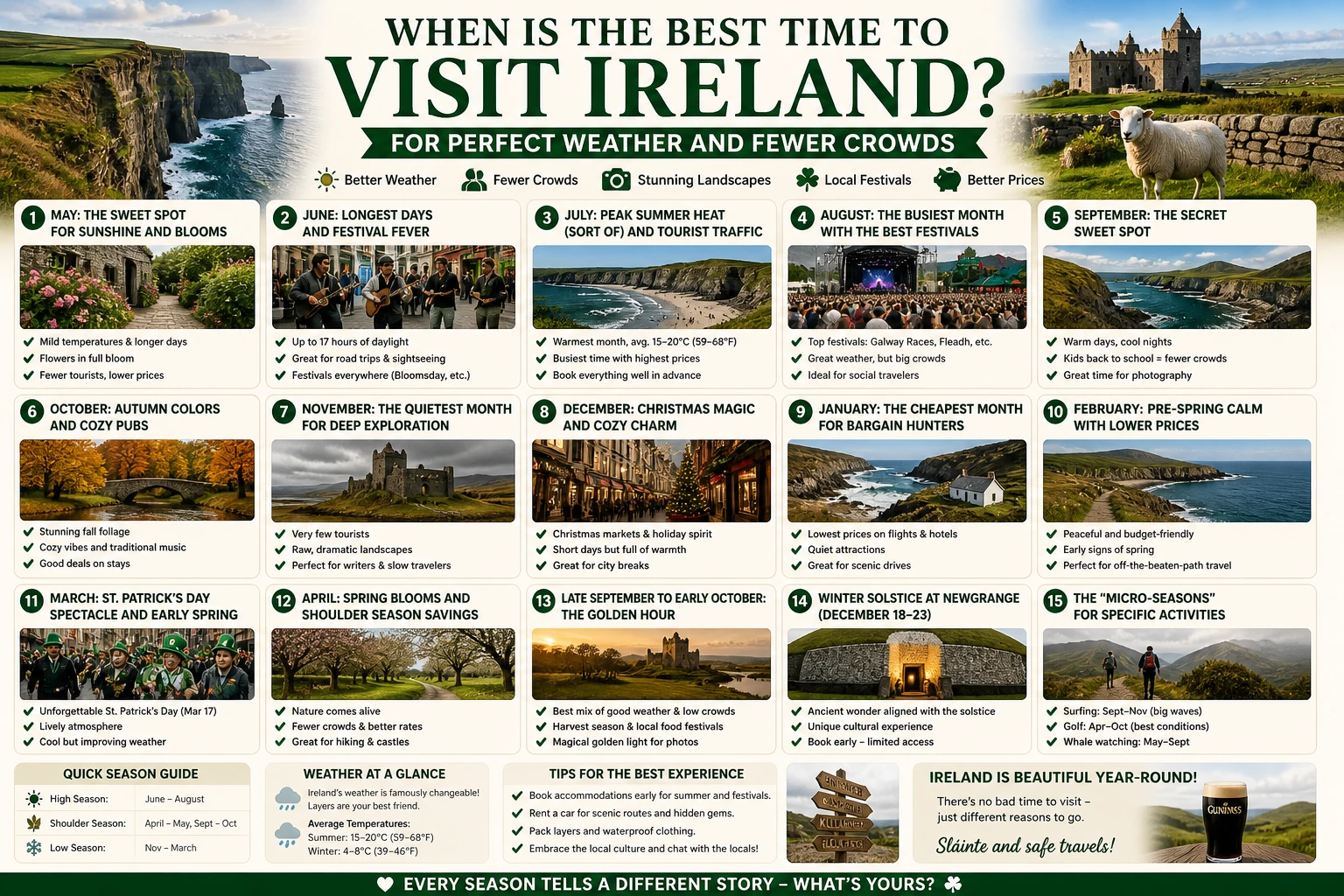
You’re probably dreaming of emerald green hills, cozy pubs, and dramatic cliffs, but you’re stuck wondering when to actually book that flight. The best time to visit Ireland is during the shoulder seasons of late spring (May-June) and early autumn (September-October), when you’ll find mild weather, fewer crowds, and lower prices. While summer offers the warmest temperatures and longest days, winter brings a magical, quieter charm with lower costs—so your ideal time really depends on what kind of Irish adventure you’re after.
When Is the Best Time to Visit Ireland for Perfect Weather and Fewer Crowds?
Ireland’s weather is famously unpredictable, but that’s part of its charm. The country experiences a temperate maritime climate, meaning mild temperatures year-round (rarely below 32°F or above 70°F). The key is balancing your priorities: do you want sunny skies and bustling festivals, or misty landscapes and empty castles? Let’s break down the best times for every type of traveler.
1. May: The Sweet Spot for Sunshine and Blooms
Best for: Nature lovers and photographers
May is arguably the most beautiful month in Ireland. The countryside bursts into life with vibrant green pastures, blooming rhododendrons, and wildflowers carpeting the hillsides. Temperatures hover around 50-60°F, making it perfect for hiking without breaking a sweat. You’ll still get long daylight hours (sunset around 9 PM), but without the summer crowds that peak in July and August.
Address: Any national park—Killarney, Connemara, or the Burren
Hours: Daylight from 5:30 AM to 9:30 PM
Price: Mid-range for flights and accommodation (expect to pay 20-30% less than July)
May also hosts the Cork International Choral Festival and the Bloom Festival in Dublin, adding cultural flair. The only downside? It can still be a bit chilly at night, so pack layers.
2. June: Longest Days and Festival Fever
Best for: Festivals and outdoor adventurers
June brings the summer solstice, meaning up to 17 hours of daylight—ideal for squeezing every drop out of your trip. The weather is generally mild (55-65°F), with occasional rain showers that pass quickly. This is prime time for the Cliffs of Moher, Ring of Kerry, and Giant’s Causeway, as the landscapes are lush and the light is golden.
Address: Dublin for St. Patrick’s Festival (though March is the main event, June has the Bloomsday Festival)
Hours: Sunrise around 5 AM, sunset after 10 PM
Price: Moderate—still cheaper than July/August
June is also when the Galway International Arts Festival kicks off, and the Dingle Races bring horse racing to the coast. Book accommodations at least 3 months in advance, as this is when savvy travelers snap up the best deals.
3. July: Peak Summer Heat (Sort Of) and Tourist Traffic
Best for: Families and beach lovers
July is Ireland’s warmest month, with average highs of 66°F (19°C)—don’t expect tropical heat, but it’s perfect for swimming in the Atlantic if you’re brave. The days are long and often sunny, but rain is still possible. This is when Ireland’s famous beaches, like Inchydoney in Cork or Portrush in Antrim, come alive.
Address: Any coastal town—Kinsale, Dingle, or Westport
Hours: 6 AM to 10 PM daylight
Price: Peak season—flights and hotels are 40-60% more expensive than in April
The downside? Crowds are thick at major attractions. The Cliffs of Moher can feel like a theme park, and parking at the Ring of Kerry can be a nightmare. If you’re flexible, consider visiting lesser-known spots like the Beara Peninsula or the Aran Islands.
4. August: The Busiest Month with the Best Festivals
Best for: Culture vultures and night owls
August is Ireland’s busiest tourist month, but it’s also when the country throws its biggest parties. The Galway Races, the Electric Picnic music festival, and the Puck Fair in Killorglin draw massive crowds. The weather is similar to July—mild with occasional rain—but the atmosphere is electric.
Address: Galway City for the Races, Stradbally for Electric Picnic
Hours: Daylight until 9 PM, but pubs stay open late
Price: Highest of the year—book everything months ahead
If you hate crowds, skip August. But if you want to experience Ireland’s legendary hospitality at its most vibrant, this is your month. Just be prepared for traffic jams on the M50 around Dublin and limited availability in popular B&Bs.
5. September: The Secret Sweet Spot
Best for: Budget travelers and solo adventurers
September is my personal favorite. The summer crowds vanish, the weather remains pleasant (50-65°F), and the landscapes take on a golden hue as the heather blooms on the mountains. You’ll find significantly lower prices on flights and accommodation, and many attractions offer reduced rates.
Address: Connemara National Park or the Dingle Peninsula
Hours: Daylight from 7 AM to 8 PM
Price: 25-35% cheaper than August
September also hosts the Dublin Fringe Festival and the Galway Oyster Festival, offering unique cultural experiences without the July chaos. The only catch? Some coastal ferry services and tourist shops reduce hours after mid-September.
September: The Secret Sweet Spot can be a strong window for travelers planning the best time to visit ireland? a season-by-season look for 2026, especially if you care about the balance between weather, crowds, and overall comfort. Conditions during this period often shape trail access, sightseeing quality, hotel pricing, and how easy it is to enjoy the destination at a relaxed pace.
For many visitors, september: the secret sweet spot is best when the goal is matching the trip to your priorities. If you plan around sunrise activities, flexible bookings, and the most popular attractions, this timing can help you get a more rewarding and better organized trip.
6. October: Autumn Colors and Cozy Pubs
Best for: Hikers and foodies
October transforms Ireland into a palette of amber, red, and gold. The weather cools to 45-55°F, with more frequent rain, but the crisp air and stunning foliage make it worth it. This is prime time for pub hopping—after a day exploring, nothing beats a peat fire and a pint of Guinness.
Address: Killarney National Park for autumn colors, any traditional pub
Hours: Daylight from 8 AM to 6:30 PM
Price: Low season—great deals on flights
The Cork Food Festival and the Dublin Theatre Festival run in October, and you’ll often have entire castles or hiking trails to yourself. Just pack a waterproof jacket and sturdy boots.
October: Autumn Colors and Cozy Pubs can be a strong window for travelers planning the best time to visit ireland? a season-by-season look for 2026, especially if you care about the balance between weather, crowds, and overall comfort. Conditions during this period often shape trail access, sightseeing quality, hotel pricing, and how easy it is to enjoy the destination at a relaxed pace.
For many visitors, october: autumn colors and cozy pubs is best when the goal is matching the trip to your priorities. If you plan around sunrise activities, flexible bookings, and the most popular attractions, this timing can help you get a more rewarding and better organized trip.
7. November: The Quietest Month for Deep Exploration
Best for: Introverts and photographers
November is Ireland’s quietest tourist month. The weather is chilly (40-50°F) and rainy, but the low light creates dramatic, moody landscapes perfect for photography. You’ll find rock-bottom prices on flights and accommodation, and attractions like the Rock of Cashel or Newgrange are nearly empty.
Address: The Burren in County Clare or the Wild Atlantic Way
Hours: Daylight from 8 AM to 5 PM
Price: Cheapest of the year—flights from the US can be under $400 round trip
The downside? Many outdoor attractions close for winter, and some rural B&Bs shut down entirely. But if you’re after solitude and don’t mind rain, November offers an authentic, uncrowded Ireland.
November: The Quietest Month for Deep Exploration can be a strong window for travelers planning the best time to visit ireland? a season-by-season look for 2026, especially if you care about the balance between weather, crowds, and overall comfort. Conditions during this period often shape trail access, sightseeing quality, hotel pricing, and how easy it is to enjoy the destination at a relaxed pace.
For many visitors, november: the quietest month for deep exploration is best when the goal is matching the trip to your priorities. If you plan around sunrise activities, flexible bookings, and the most popular attractions, this timing can help you get a more rewarding and better organized trip.
8. December: Christmas Magic and Cozy Charm
Best for: Couples and holiday travelers
December brings twinkling Christmas markets, festive lights, and a cozy atmosphere that’s hard to beat. Dublin’s Grafton Street glows with decorations, and Galway’s Christmas market is a delight. The weather is cold (35-45°F) with frequent rain and occasional snow in the mountains.
Address: Dublin’s Christmas markets, Galway’s Eyre Square
Hours: Daylight from 8:30 AM to 4:30 PM
Price: Moderate—holiday season prices, but not as high as summer
The biggest draw? New Year’s Eve in Dublin, with fireworks over the River Liffey. Just be prepared for shorter days and the possibility of stormy weather.
December: Christmas Magic and Cozy Charm can be a strong window for travelers planning the best time to visit ireland? a season-by-season look for 2026, especially if you care about the balance between weather, crowds, and overall comfort. Conditions during this period often shape trail access, sightseeing quality, hotel pricing, and how easy it is to enjoy the destination at a relaxed pace.
For many visitors, december: christmas magic and cozy charm is best when the goal is matching the trip to your priorities. If you plan around sunrise activities, flexible bookings, and the most popular attractions, this timing can help you get a more rewarding and better organized trip.
9. January: The Cheapest Month for Bargain Hunters
Best for: Extreme budget travelers
January is Ireland’s coldest and quietest month, with temperatures averaging 38-45°F. Rain is frequent, and some attractions close for maintenance. But if you’re on a tight budget, this is your month—flights can be 60% cheaper than July, and hotels offer deep discounts.
Address: Dublin for museums and indoor attractions
Hours: Daylight from 8 AM to 5 PM
Price: Cheapest—flights from Europe under €50
The key is focusing on indoor activities: the National Museum of Ireland, Kilmainham Gaol, and Dublin’s pubs. January also has the St. Brigid’s Day celebrations (Feb 1), but it’s mostly a quiet, reflective time.
January: The Cheapest Month for Bargain Hunters can be a strong window for travelers planning the best time to visit ireland? a season-by-season look for 2026, especially if you care about the balance between weather, crowds, and overall comfort. Conditions during this period often shape trail access, sightseeing quality, hotel pricing, and how easy it is to enjoy the destination at a relaxed pace.
For many visitors, january: the cheapest month for bargain hunters is best when the goal is matching the trip to your priorities. If you plan around sunrise activities, flexible bookings, and the most popular attractions, this timing can help you get a more rewarding and better organized trip.
10. February: Pre-Spring Calm with Lower Prices
Best for: History buffs and city breakers
February remains cold and damp (38-48°F), but the days start getting noticeably longer. This is a great month for exploring Ireland’s cities—Dublin, Cork, and Galway—without the crowds. Many museums and galleries offer reduced admission.
Address: Dublin Castle, Cork’s English Market, Galway’s Latin Quarter
Hours: Daylight from 7:30 AM to 6 PM
Price: Still low—good deals on package holidays
February also hosts the Dingle Food Festival and the Dublin International Film Festival. The landscapes are still beautiful, but expect muddy trails and gray skies.
February: Pre-Spring Calm with Lower Prices can be a strong window for travelers planning the best time to visit ireland? a season-by-season look for 2026, especially if you care about the balance between weather, crowds, and overall comfort. Conditions during this period often shape trail access, sightseeing quality, hotel pricing, and how easy it is to enjoy the destination at a relaxed pace.
For many visitors, february: pre-spring calm with lower prices is best when the goal is matching the trip to your priorities. If you plan around sunrise activities, flexible bookings, and the most popular attractions, this timing can help you get a more rewarding and better organized trip.
11. March: St. Patrick’s Day Spectacle and Early Spring
Best for: Party-goers and culture enthusiasts
March is famous for St. Patrick’s Day (March 17), which turns Ireland into a week-long celebration. Parades, music, and pub crawls dominate, especially in Dublin. The weather is still cool (40-50°F), but early spring flowers like daffodils start appearing.
Address: Dublin’s St. Patrick’s Day parade, any pub in Ireland
Hours: Daylight from 7 AM to 7 PM
Price: Moderate—prices spike around St. Patrick’s Day
The downside? Accommodation in Dublin sells out months in advance, and prices triple. If you want to avoid the madness, skip Dublin and head to smaller towns like Kilkenny or Westport for more local celebrations.
March: St. Patrick’s Day Spectacle and Early Spring can be a strong window for travelers planning the best time to visit ireland? a season-by-season look for 2026, especially if you care about the balance between weather, crowds, and overall comfort. Conditions during this period often shape trail access, sightseeing quality, hotel pricing, and how easy it is to enjoy the destination at a relaxed pace.
For many visitors, march: st. patrick’s day spectacle and early spring is best when the goal is matching the trip to your priorities. If you plan around sunrise activities, flexible bookings, and the most popular attractions, this timing can help you get a more rewarding and better organized trip.
12. April: Spring Blooms and Shoulder Season Savings
Best for: Garden lovers and cyclists
April is when Ireland truly awakens. The weather warms to 45-55°F, and the countryside explodes with bluebells, daffodils, and cherry blossoms. The crowds are still thin, and prices are reasonable—this is the start of the shoulder season.
Address: Powerscourt Gardens, Mount Usher Gardens, or the Ring of Kerry
Hours: Daylight from 6:30 AM to 8:30 PM
Price: Low to moderate—great value
April also has the Cork City Marathon and the Belfast International Arts Festival. It’s a fantastic month for cycling the Wild Atlantic Way or hiking the Wicklow Way, as the trails are less muddy than winter.
April: Spring Blooms and Shoulder Season Savings can be a strong window for travelers planning the best time to visit ireland? a season-by-season look for 2026, especially if you care about the balance between weather, crowds, and overall comfort. Conditions during this period often shape trail access, sightseeing quality, hotel pricing, and how easy it is to enjoy the destination at a relaxed pace.
For many visitors, april: spring blooms and shoulder season savings is best when the goal is matching the trip to your priorities. If you plan around sunrise activities, flexible bookings, and the most popular attractions, this timing can help you get a more rewarding and better organized trip.
13. Late September to Early October: The Golden Hour
Best for: Romantic getaways and wine lovers
This two-week window (around September 20 to October 10) is a hidden gem. The weather often stabilizes into a “Indian summer” with clear skies and 60°F temperatures. The autumn colors peak, and the harvest season brings fresh seafood and local produce.
Address: The Dingle Peninsula or the Burren
Hours: Daylight from 7:30 AM to 7:30 PM
Price: Low season—excellent deals
This period avoids the summer crowds and the winter chill. It’s perfect for driving the Wild Atlantic Way without traffic, or enjoying a quiet pint in a coastal pub.
Late September to Early October: The Golden Hour can be a strong window for travelers planning the best time to visit ireland? a season-by-season look for 2026, especially if you care about the balance between weather, crowds, and overall comfort. Conditions during this period often shape trail access, sightseeing quality, hotel pricing, and how easy it is to enjoy the destination at a relaxed pace.
For many visitors, late september to early october: the golden hour is best when the goal is matching the trip to your priorities. If you plan around sunrise activities, flexible bookings, and the most popular attractions, this timing can help you get a more rewarding and better organized trip.
14. Winter Solstice at Newgrange (December 18-23)
Best for: History enthusiasts and spiritual seekers
If you can time your visit around the winter solstice (December 21), you can witness the sunrise illuminate the inner chamber of Newgrange, a 5,200-year-old passage tomb. This is a once-in-a-lifetime experience, but spots are limited to a lottery system.
Address: Newgrange, County Meath (about 45 minutes north of Dublin)
Hours: Sunrise around 8:40 AM, tours run 9 AM to 4 PM
Price: Free if you win the lottery (otherwise €18 for standard tour)
The lottery opens in September, so apply early. Even if you don’t win, the winter solstice celebrations at the Hill of Tara are magical.
Winter Solstice at Newgrange (December 18-23) can be a strong window for travelers planning the best time to visit ireland? a season-by-season look for 2026, especially if you care about the balance between weather, crowds, and overall comfort. Conditions during this period often shape trail access, sightseeing quality, hotel pricing, and how easy it is to enjoy the destination at a relaxed pace.
For many visitors, winter solstice at newgrange (december 18-23) is best when the goal is matching the trip to your priorities. If you plan around sunrise activities, flexible bookings, and the most popular attractions, this timing can help you get a more rewarding and better organized trip.
15. The “Micro-Seasons” for Specific Activities
Best for: Activity-focused travelers
– Surfing: September-October (warmest water, best waves off County Sligo)
– Whale watching: October-March (humpbacks and orcas off the coast of Cork)
– Golf: May-September (long days, dry courses, but book tee times in advance)
– Fishing: March-October (salmon and trout season)
Each activity has its own optimal window, so plan around your passion.
The “Micro-Seasons” for Specific Activities can be a strong window for travelers planning the best time to visit ireland? a season-by-season look for 2026, especially if you care about the balance between weather, crowds, and overall comfort. Conditions during this period often shape trail access, sightseeing quality, hotel pricing, and how easy it is to enjoy the destination at a relaxed pace.
For many visitors, the “micro-seasons” for specific activities is best when the goal is matching the trip to your priorities. If you plan around sunrise activities, flexible bookings, and the most popular attractions, this timing can help you get a more rewarding and better organized trip.
Conclusion
The best time to visit Ireland truly depends on your travel style. For the perfect balance of weather, crowds, and cost, aim for May-June or September-October. If you’re on a budget, January-February offers unbeatable prices. And if you want to experience Ireland’s legendary festivals, July-August or March (for St. Patrick’s Day) won’t disappoint. No matter when you go, pack layers, a rain jacket, and an open mind—Ireland’s unpredictable weather is part of its magic. Sláinte!
similar posts
Where to Stay in San Diego in 2026: Best Neighborhoods & Hotels
17 Essential Travel Photography Tips for 2026: Capture Your Adventures Like a Pro
The Ultimate Guide to the Top 10 Places to Visit in the World in 2026
15 Essential Business Travel Tips for 2026: Work Smarter on the Road
15 Must-See Places to Visit in the US in 2026
Best Time to Visit the Grand Canyon in 2026